

Your Promotions Are Missing Your Core Shoppers

I just booked my Expo West Airbnb which means it is getting serious and the Super Bowl of CPG is fast approaching. If you’re going to be at the show, please let me know, it would be great to meet up.
I have shared my Expo West tips before, but (in my Anthony Bourdain voice) stay in Newport Beach. Rent a car. Get a cheap Airbnb by the beach. Stop at Dory’s Deli. Get the breakfast burrito. Eat it outside. Go to the show. Get a cocktail with friends. Skip the parties with silly cover fees. Wake up rested by the beach. Go back to Dory’s.
It’s much more enjoyable and you won’t have to pay $500 a night to stay in a nearby Disneyland adjacent motel that for some reason has a Dutch countryside theme to it.
It is a slightly shorter Consumer Mindset this week as I continue to test the perfect length for this newsletter, but an important one nonetheless.
TPRs (temporary price reduction) are the fixture for most brand’s trade spend strategy.
That is because for the most part they work and they do their job of moving more units during a certain time frame.
It’s a pretty obvious strategy when you boil it down to the basics and it’s mandatory as part of your strategy with any retailer.
You reduce the price of your product on shelf so that you lower the barrier of entry for new potential consumers to try your product and the retailers sell more units during that period and make more money.
The issue is in the post-promo analysis.
When you go to check the sales movement a couple days or weeks after the promotion, only to see that your sales are back to the same weekly amount they were before or worse, they have dipped below that threshold.
Most brands after a TPR will ask, how much did we move during the promotion? When they should ask, who bought our product during the promotion?
On the surface we all assume that TPRs will lead to new consumers trying it, loving it, and continuing to buy.
The issue is that the cycle is predicated on high-intent, net new consumers trying your product and continuing to buy, but unfortunately when we look at the data, that is only a small sliver of the consumer pie that is interacting with most TPRs.
When your brand is discounted, a few things happen in the mind of the consumer:
More consumers notice the brand
More consumers consider it acceptable for their needs
More consumers are willing to try it for the first time
These are all positives, but they aren’t indicators of new demand.
Instead these are consumers who are usually doing one of the following:
Switching from a nearby brand in the set that they usually purchase
Trading down from a higher‑priced option because it is now less
Buying your brand instead of private label because it is now less
These are switch buyer profiles. The snip snap snip snap, leaving your brand exhausted trying to fight for their business which you will most likely never get.
They have a low-level of loyalty and usually are going to be loyal to the cheapest option.
Yes, some can be moved to core buyer, but it’s probably best to focus on getting light or lapsed buyers back into the fold with your TPRs. The positive is that means that deeper discount isn’t what is needed, but a smaller one as a nudge to buy again.
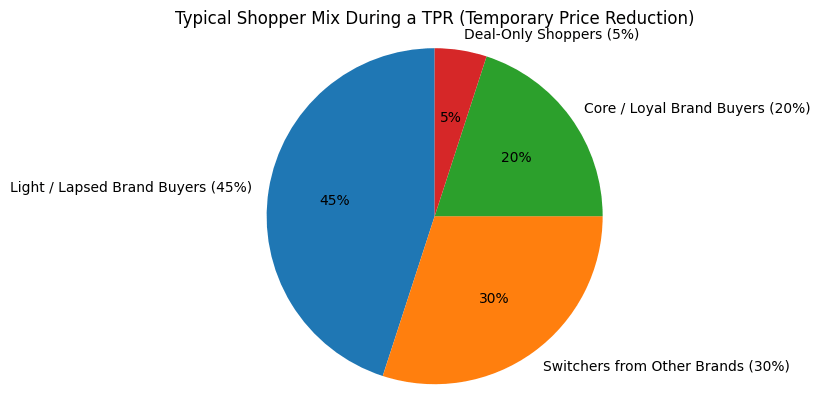
When we look at the data of the shopper types that engage with TPRs (Nielsen & Circana) the breakdown looks something like this:
50–70% of promo volume is not incremental
20–30% of promo buyers are existing brand buyers buying sooner or more
Switching dominates promo lift in crowded categories
Deal-only behavior exists but is a minority
Having 65% of the shopper profiles be shopper types that aren’t going to have a positive impact on your sales post-promotion is a problem.
You might ask yourself, why is that number 65%, if only the deal shoppers and switch buyers are negative shopper profiles.
The biggest negative impact shoppers here are actually your loyal ones (it’s always the ones you trust the most).
They would have already purchased your product at full price and will continue to do so, but now they are buying it at a discount, and most likely buying more of it. Meaning when they come back for their weekly visit next week, they’ll skip your brand.
Consumers have a set amount that they buy of your brand. If they buy more in one week, that does not increase their weekly consumption to a new threshold, it just means they will buy less until they return to their normal purchasing habits.
So now that I have scared you to the point that almost 2 out of every 3 customers who buyers your brand on promo is not increasing the baseline, let me switch to actually being helpful and outline a few ways you can increase the exposure to that 45% of light, new, or lapsed buyers that you really want to get buying your brand on promo so that the trailing lift the following week shows an increase.
Secure new placement - If you’re on promotion you need to secure new placement in the store. Athletic Brewing is the gold standard here. They seem to always be on promotion, especially at Whole Foods, but they don’t implement TPRs to move more units from that promotion, they implement TPRs to secure floor placement and large merchandising displays. That leads to way more sales to net-new shoppers than the incentive of the TPR itself. You have to move your brand around the store to attract new shoppers.
Wider, not deeper - I would prefer a brand be on promotion with a higher frequency and a lower deal type. This will shift the pie to be dominated more by those light buyers. You’re trying to continuously increase basket penetration of your product, deep discounts usually increase the sliver for loyal and deal shopper profiles.
Show Up - Similar to new placement, if you’re on promo, you need to increase the exposure of that to the types of shoppers you want to attract. Showing up whether that is through brand ambassadors doing store visits or scheduling your demos to coincide with your promotions are both strong options. I also am an advocate for brand increasing ad spend to support promotions. When you can get consumers to come into the store with the mindset that they are trying your brand, that is a very high-intent shopper.
TPRs have always been here.
They will continue to be the first line of trade promotion strategy because they serve the needs of the retailer.
TPRs also work, which is why they are still here, you just need to find the right mix for your brand, be religious about the post-promo data and ask yourself internally how you maximize the promotion with the right type of shopper for your brand.